Monday, April 10, 2017

A Free Meal


So, yesterday began a new week, Easter week, and I was glad to put the last one behind me.  It was a humdinger.  I guess that was why I nearly forgot about the Lord's Supper yesterday.  Yep, true confession.  By a small miracle of God, He brought it to my mind as I was getting ready to go set up for church.  See, in our little church, which meets in a school, we set up every Sunday morning, and then tear down afterwards.

My absentmindedness meant I had to stop at Publix on the way down and pick up a loaf of fresh-baked bread and some grape juice.  Fortunately, I carry the cloths, napkins, goblets and such around in my car.  I know - - a special kind of weird.  At any rate.... my friends Carolyn, Cindy and Sloania helped get the bread "chopped", juice poured and everything in place.  Communion went off without a hitch, praise the Lord!  I'm glad that there is no one-and-only-one "right" way to celebrate communion, apart from the fact that it is sacrament for Christian believers only.  At our church, the elements are at the front, and we process row-by-row to the table, where we take the elements, saying "The body of Christ, the blood of Christ.  Thanks be to God!"

Jesus commanded that we take communion to remember His sacrifice, but not how often we should celebrate that sacrament.  Our church does it about once a month.  It is a mysterious thing, The Lord's Supper, communion.  I was thinking last night about yesterday's "near debacle" and about Jesus appearing to the two followers on the road to Emmaus, after His resurrection.  I found it curious that He appeared first to Mary, outside the tomb, but even downright strange that He appeared to two rather obscure followers seven miles outside Jerusalem.  Why would He do that?  Don't you think that He "should" have appeared directly to The Twelve (apostles)?  This is another curious thing:  the two Emmaus road followers of Jesus did not recognize Him until He did one thing.  Do you remember what that was?

30When he was at table with them, he took the bread and blessed and broke it and gave it to them. 31And their eyes were opened, and they recognized him. And he vanished from their sight. 32They said to each other, “Did not our hearts burn within us while he talked to us on the road, while he opened to us the Scriptures?” 33And they rose that same hour and returned to Jerusalem. And they found the eleven and those who were with them gathered together, 34saying, “The Lord has risen indeed, and has appeared to Simon!” 35Then they told what had happened on the road, and how he was known to them in the breaking of the bread.
Luke 24:30-35 (ESV)

When did they recognize Him?  When He was breaking the bread with them in communion, in fellowship.  Wow.  Who would have imagined their eyes would have been opened at that moment?! He is, in His own words, the Bread of Life (John 6:35).  When we seek Him, study about Him, eat of that spiritual bread, He opens our eyes then too.  The Lord's Supper not only reminds us of His death, burial and resurrection; it also reminds us that He is life, abundant life!  I love how this story stars "the everyday believer", not the "stars of the show" (the Twelve).  Jesus demonstrated that His food is freely available for every one of His beloved, not just those who are them most "visible" or "out front".

This morning I got up much earlier than usual to help with a church outreach.  We are making a big push to invite folks to church on Easter Sunday, since many who don't usually attend will often look for some church to attend that day.  So, four of us Rising Hills Church members met in a parking lot to assemble and then distribute (when "the traffic signal was red"!) over 100 paper bags containing a FREE Bojangles biscuit, jelly packet, juice and a card about our Easter services.  There it is again - - - bread and juice.

We weren't celebrating the Lord's Supper this morning, of course.  We were blessing commuters who were facing another Monday.  But, those elements given today were prayed over by many; perhaps soul-hungry people saw or will see Jesus in the receiving of them.  Hopefully, their hearts will burn within them, in a desire to know more about the one and only Savior.

By the way, last year I wrote in the blog a whole series of Easter posts, laying out a timeline of Jesus' acts during Passion Week.  If you would like to read them, they begin with this one.

http://resplendentdaughter.blogspot.com/2016/03/10-days-that-changed-world.html

Happy Monday, folks!  (Don't forget to eat.)


Wednesday, April 5, 2017

The Most Holy Place: Where Earth and Heaven Met (3)


Let them make for me a sanctuary, so that I may live among them.
Exodus 25:8 (NET)

Why all this falderal about The Tabernacle (and its more recent translation, The Temples) anyhow?
What's the big deal?  Why is Resplendent Daughter spending so much time on this topic?  Aren't we supposed to be studying Hebrews?!  Ha, ha, well, we are!  Our main text for today is Hebrews 9:11-14 (ESV).

11But when Christ appeared as a high priest of the good things that have come,ethen through the greater and more perfect tent (not made with hands, that is, not of this creation) 12he entered once for all into the holy places, not by means of the blood of goats and calves but by means of his own blood, thus securing an eternal redemption. 13For if the blood of goats and bulls, and the sprinkling of defiled persons with the ashes of a heifer, sanctifyf for the purification of the flesh, 14how much more will the blood of Christ, who through the eternal Spirit offered himself without blemish to God, purify ourg conscience from dead works to serve the living God. 

I was surprised to learn1 that the Tabernacle's construction and rituals, the Levitical priesthood, and the transporting of the Tabernacle from place to place are mentioned in 50 chapters of our Bible.  So, to ignore the study of this very important Bible component would be akin to ignoring a book of the Bible the size of Ezekiel.  Additionally, it is a representation of the true Tabernacle in Heaven.  We have already seen in previous posts parallels to the life and ministry of Jesus Christ.  But, there is one additional reason, one that resonates the most with me; and, that is the one I want to explore today.  In today's post, we will focus on the last and most innermost area of the Tabernacle/Temple, the most "sacred ground", the area called The Holy of Holies.

First, let's examine the physical characteristics of this most holy place.2 

Its entrance was marked by a gorgeous piece of tapestry, similar to the one that marked the entrance to The Holy Place.  (If you have been following my blog, I wrote about that room in the last post.) 
The description of that tapestry can be found in Exodus 26:31-34.  The base material was the finest of linen and it was woven through with scarlet, purple and blue threads, with artistic renderings of cherubim (a specific class of angelic beings - - see Ezekiel 1, 10 and Isaiah 6).  No priest, except for the high priest, was ever allowed to touch this curtain; and, the high priest could touch it only once each year.

The room itself was 15'x15' square. There was no light in the room.  When light was needed, that is, once a year when the high priest (shoeless and with head bowed) entered on the Day of Atonement, the Shekinah Glory of God Almighty, appeared as a brilliant cloud, descended and lit the room.  The ark contained one piece of furniture only: the ark of the covenant. Now, you will be glad to know that I am not going to launch off into an extensive exploration of the ark of the covenant in this post.  But, here is a brief description.3  

The ark was constructed of acacia wood and was 45" long, and 27" high and wide.
It was overlaid with pure gold.  Around the perimeter of the ark's top was a raised "crown", ornate like a crown, and the top of the ark was overlaid with the purest gold.  This flat surface was called the mercy seat.  It was on this mercy seat that the priest would sprinkle the blood of the Passover lamb, when he entered the Holy of Holies on the Day of Atonement.  When this occurred, the presence of God Himself, the Shekinah Glory, would appear and fill the room.

And now (finally), your "big takeaway":
The Holy of Holies still exists today.  
"What?!", you exclaim.  "The Tabernacle is nonexistent.  The Temples have been destroyed.  How can that be?"
One of my very favorite verses in the Bible is Luke 23:45 - - 
"The sun stopped shining (was darkened) and the veil of the Temple was torn down the middle."

The Temple veil was 60 feet long/tall and 30 feet wide, weighing thousands of pounds.  Moreover, it was (depending on your source) from 1 to 4 inches thick.   This was a massive curtain.  Luke tells us that, at the moment of Jesus' death, presumably God (who else?) split that sacred curtain (which no one was to touch except once a year, remember?) right down the middle, from top to bottom.

Why?  Why would He do that?  What does it mean?

Jesus had just poured out His life on the Cross, paralleling the sacrifice of the Passover Lamb in the Temple at that same time.  It is entirely possible that, at the moment Jesus died, the High Priest was IN the Holy of Holies sprinkling blood on the mercy seat.  The times of day (when Jesus died and when that lamb sacrifice was to occur on the Day of Atonement) match up!

When Jesus died for our sins, His blood forever paid the price.  There was no longer any need for a physical ark or mercy seat.  The "curtain" separating God from mankind was torn because Jesus Christ, our High Priest, had made an eternal sacrifice, an eternal way for mankind to come to God.

"But, ... you said the Holy of Holies still exists today?"  Yes, that Holy of Holies is in the heart of each and every believer in Jesus, every follower who has asked Him to sprinkle His blood on his heart. At the moment a person asks Jesus to come into the very core of their eternal being, into his spirit, and merge His Holy Spirit with his, that spiritual veil that separates sinful man from a holy God is torn, forever torn.  The Holy Spirit then dwells in the "heart" of every person who gives his or her life to Jesus Christ as Savior and Lord.  Hallelujah!  Let's praise Him!


Sources:

Friday, March 31, 2017

Where Earth and Heaven Met, deuxieme partie


Well, I have to keep my high school French sharp, you know.... :) "Deuxieme partie" is French for "part two", which begs the question of why there is a big, golden 7 up there.  But, hang on....

You know how folks will ask, "If you were going to be marooned on a desert island all alone for the rest of your life, and you could take 3 things with you, what would they be?"

I think about that question as I contemplate what God Almighty chose to include in the "furnishings" of the Tabernacle (and later the Temple's) "holy place".  There were only three items.  Are there any indications in Scripture to teach us why He chose those items?  Let's investigate!

First of all, all three furnishings were made of acacia wood overlaid with pure gold, and the accompanying items (such as tableware and coal pans) were made of pure gold.

1.  The Table of Shewbread (aka Table of the Presence)1
"Shewbread" literally means "bread of the face" or bread set out before the face of God.
As one entered The Holy Place, this table was on the right hand side.  (This is the first mention of the word "table" in the Bible. Table is a symbol of communion and fellowship.  More about that in a moment.) On the table were placed every Sabbath 12 loaves of bread, made from the finest flour and unleavened.  They were arranged in two rows of six, on the table.  Each loaf represented one of the tribes of Israel. How beautiful that, even though only Levitical priests were allowed in the Holy Place, all the people of the 12 tribes were represented there before the Lord, by the 12 loaves... Sprinkled over the loaves was the oil of frankincense, which consecrated the bread unto the Lord, essentially making it a grain offering.  At the end of the week, the "old" bread was consumed by the priests and new bread took its place on the table.  Tradition holds that 8 priests would hold hands standing around the table before consuming the old loaves.  Such a sacred communion.
The Table of Shewbread represents our Savior, Jesus Christ.  It is through Him, and only through Him, we have communion with our Triune God.  Frankincense was given to Him by the 3 Wise Men, you will recall, as a birthday gift.  No accident, that.  He called Himself the Bread of Life in John 6:35, 51-58.  This table was part of God's "old covenant".  The covenant meal Jesus established with His disciples shortly before His death represents His New Covenant.  That meal represents the believer's eating the "body" (bread) and blood (wine) of Christ on a regular basis to remind us of His sacrifice's all-sustaining and eternal nature.
Bible references to explore:  Exodus 25:23-30; Leviticus 24:5-9.

2.  The Golden Lampstand2
There were no dimensions given for this item.  (Who, after all, can measure the light of God?)
The instructions for making it are found in Exodus 25:31-40.  It was to be made entirely of gold (which caused it to weigh 75-100 pounds) and fashioned by the best artisans.  A strong motif in the design was the flower of the almond tree.  In that part of the world, the almond tree was the first to awake from the darkness of Winter, the first tree to respond to the increased light of Spring.  The lampstand had a vertical shaft, at the end of which was a bowl for the oil.  In addition, there were three curved branches, curving upward, to form 6 more bowls.  All seven were in the shape of the almond blossom.
The seven, tiny bowls, were to be kept burning at all times.  The High Priest was responsible for the care of the lampstand, to ensure its wicks of flax were adequate and that the finest olive oil was abundant, so that the eternal flame burned in the Holy Place (Leviticus 24:3).  There were no windows in the Holy Place.  None were needed.
The lampstand represents the Godhead, and points forward to Jesus.  Zechariah 4:1-4 tells us that this oil represents the Holy Spirit of God.  When the Holy Spirit fell on the believers at Pentecost, He represented Himself as "tongues of fire" over the head of each believer there assembled (Acts 2:3-4).  Jesus referred to Him as fire in Matthew 3:11-12.  And, Paul exhorts us to "not quench the Spirit" (1 Thessalonians 5:19).  Jesus often called Himself the Light of the World (John 9:5; 8:12).  And, in Psalm 27:1, God the Father reminds us that He is our Light and our Salvation.  In the Bible 7 is the number which represents completion and perfection.3  Our perfect God, the Three-In-One.

3.   The Altar of Incense4
(Exodus 30:34-38)
It was commanded that this wooden altar, overlaid with gold, be the tallest structure in the room.  It stood about 3 feet tall.  Some of the characteristics of this altar, such as the four horns on the four corners, mimicked the bronze altar just outside the Holy Place. There were coals kept burning on this altar, and they were brought there from the Bronze Altar in a golden coal pan.   As noted in its name, an incense, made of the finest spices and frankincense oil, was burned on this inner altar twice a day. The exact combination of incense is lost to us today.  But, this combo was to be used by no other Israelite for any other purpose.  It was a holy combination, used only for the worship of God on the Altar of Incense.  The High Priest, after he had tended the Golden Lampstand morning and evening, would offer an incense offering on the altar.  In this way, a perpetual sweet smell would pervade the Holy Place. (This fragrance of love and worship expressed the delight of one whose sins had been forgiven!) Additionally, once a year, on the Day of Atonement, after the annual sin offering (Passover Lamb) had been offered, some of its blood would be rubbed on the horns of this incense altar, as the High Priest was proceeding into the Most Holy Place (which we will examine in an upcoming blog).
The golden altar of incense has at its essence worship and praise.  It reminds us of Jesus' current ministry in Heaven, to perpetually intercede on our behalf before God the Father.


Let my prayer be set before You as incense, the lifting up of my hands as the evening sacrifice.
Psalm 141:2 

In the next post, ... the Most Holy Place!

Sources:

1   http://www.bible-history.com/tabernacle/TAB4The_Table_of_Shewbread.htm
2   http://www.bible-history.com/tabernacle/TAB4The_Golden_Lampstand.htm
3   https://www.gotquestions.org/number-7-seven.html
4   http://www.bible-history.com/tabernacle/TAB4The_Golden_Altar_of_Incense.htm
5   Wiersbe, Warren W., and Warren W. Wiersbe. The Wiersbe Bible Commentary: The Complete Old Testament in One Volume. Colorado Springs, CO: David C. Cook, 2007. Print.

Monday, March 27, 2017

Where Earth and Heaven Met, Part 1


Thus far, in our exploration of the ancient Tabernacle and Temple, we have studied what can be loosely referred to as "Temple courts" or "porches".  As we move forward, past the bronze altar and the bronze laver, the next feature to command our attention is the centerpiece of the Tabernacle/Temple structure:  the Holy Place and, within it, the Holy of Holies.

Had we been able to see this structure, sitting inside a 7.5 ft. high fence of linen, out there in the Israelite encampment, we may not have been impressed.1  To be sure the structure was large.  Its dimensions were 30 ft. by 15 ft., and 15 ft. high from floor to ceiling.  But, the tent itself did not look very attractive from the outside.  On the inside, well, that was another matter.  Exodus 26 and 36 tells us:

The tent was supported by acacia wood braces, overlaid with gold.  The braces were not solid beams. Each one was sort of like two wooden poles, with crossbars at the top, bottom and middle.  This construction made the 15-foot tall braces more lightweight and also allowed for the innermost curtain that covered them to be seen through the braces themselves.

There were four coverings that went over these braces to form the tent itself.  The innermost one was made of the finest materials, with the finest, most intricate and beautiful design known in the weaving world of that day.  Linen comprised the base fabric, but beautiful threads of blue, purple and scarlet were woven throughout the material.  Figures of angelic cherubim (whose duty is to without ceasing proclaim the holiness of God) were woven into this fine fabric. The dimensions for this covering were specified by God.  The curtain was formed from 20 vertical panels of equal length, coupled together with clasps of pure gold.  Furthermore, the curtain's bottommost edges did not touch the ground.

The covering that overlaid the most beautiful, inner one was woven from the hair of black goats. This slightly larger curtain completely covered the more inner one; it's bottommost edges DID touch the ground.  It was pieced together in a similar manner as the linen covering; but, the clasps holding it together were made of brass.

The next most outer covering was made of ram's skin, dyed red.  Like the outermost covering, which we'll get to in a moment, this one was waterproof.  It was specified to be red, which represents atonement.  Interestingly, there were no dimensions given by God for this covering.

The last of the four coverings, the one visible to passersby, was made of badger skin. No measurements were specified for this one either.  Now, as I alluded to before, badger skin (some say it was the skin of a sea animal, such as the sea cow) was not very attractive.   But, as with most things related to God, of greater importance is the inner, not the outer (Isaiah 53:2, for instance). And, the harder you search the heart of God, the more beauty you will find.

The door to this structure was supported by five beautiful pillars, acacia wood covered with gold, with each pillar sitting in a bronze base and capped on top by a gold piece.  Hanging between these pillars was woven fabric, the same as the fabric described above, in the most innermost curtain of the Tabernacle.  As a reminder, Levitical priests could approach this door after first having made a burnt offering on the bronze altar and then ceremonially washing at the bronze laver, both studied in previous posts.  But, as Christians, Jesus is our Door.  He described himself as such, likening Himself to the door of the Tabernacle, in John 10:7-9 and John 14:6.  Because of His eternal and thoroughly complete sacrifice, we are invited to approach the throne of grace boldly, at any time.  What a blessing!

Let us then with confidence draw near to the throne of grace, that we may receive mercy and find grace to help in time of need.
Hebrews 4:16 (ESV)

In Part 2, we will look at the furnishings in The Holy Place, the first compartment encountered in this ancient place where Earth and Heaven met.

Source:

1   http://www.bible-history.com/tabernacle/TAB4The_Curtain_Coverings.htm


Thursday, March 23, 2017

The Safest Place


Spending a few minutes in Ezekiel this morning, I came across in chapter 11 today's key verse, verse 8:

"You have feared a sword; so I will bring a sword upon you," the Lord God declares.
Ezekiel 11:8 (NASB)

In this passage the Israelites were in one of their infamous bouts of disobedience to their God.  They had strayed from His ways, substituting the ways, methods and "ordinances" (vs. 12) of the pagan people groups that surrounded them.  Their rulers and leaders were evil, in this regard.

The rulers' rationalization and justification to the people for doing so was, "If we don't do this the nations around us will ravage and conquer us!"  The bottom line was: they were trusting in their own power and in pagan methods to preserve their safety, instead of trusting in YHWH, their God.

There are many circumstances Satan uses to tempt us to fear.  If He can, after all, scare us out of following God boldly, then he has handicapped our effectiveness for the kingdom of God.

Is there a circumstance, or several, making you fearful today?  What is a Christian's antidote to fear?

And, what does it mean to be "safe" anyway?  Does it mean no harm will ever come to you?
No.

While walking resplendent (according to Jesus Christ's example) yields a life of peace and joy, it is not a life free of challenges and sometimes downright pain.   Why?

Let's tackle these questions.

1.  The Antidote to Fear
Simply, the antidotes to fear are prayer and trust in the One who "holds all things in His hands".  If we trust, committing ourselves and our circumstances to God, we can be certain, absolutely certain, that He will:

  • do what is right
  • guide us
  • be with us through every adverse condition
  • use all of our situations for His glory and the advancement of our kingdom
  • work things out "for our good" (especially when things seem like crap all around us).  (Romans 8:28)

It may not be that He "works things out" the way we'd like, but we can have bedrock, rock-solid trust in His goodness and His sovereignty.
Where is room for fear in that?  No room.  He, and He alone, is our "safest place".

2.   The Answer to Pain
Why must good people suffer?
First of all, there is no one truly righteous, except God.  Christians know this, as it is the first step to becoming a Christian. (Romans 3:10)
But, I'm talking about Christians, those who love God (to the best of their flawed ability) with all their hearts, minds, souls...
Why do Christians, God's family suffer?
Apart from sinful choices which bring suffering down on our own heads, the answer is hinted at in #1 above - - -
All of our life conditions, phases, seasons, circumstances are allowed us so that we can:

  • grow in our faith
  • be drawn closer to His heart
  • become more like our Savior
  • bring about the advancement of the gospel message, be instrumental in "His kingdom come, His will be done" (Matthew 6:9-13)
  • bring Him glory

So, we must not adopt the methods of the Jewish leaders in Ezekiel 11.  Their methods were to be deceived by and yield to worldly strategies and pagan philosophies to solve spiritual problems (such as dealing with fear and pain).  God's solutions trump and are superior to man's (Satan's) counterfeits every.single.time.

The question is: will we, God's beloved people, be bold and fearless, moving forward in faith and courage, to follow our King in all of life's circumstances?  Are we willing to follow Him and His ways obediently, according to the Word of God, no matter the personal cost?  Is the battle worth it?  Is HE worth it?

Yes, and so be it.   I believe He is worth it all.

Heavenly King and Father God,
"Give us wisdom.  Give us courage, for the facing of this hour....for the facing of this hour!"
In Jesus' name, amen.

Sunday, March 19, 2017

The Bronze Laver


For a quick review, we are in the book of Hebrews and are currently somewhere in chapters 9-10, which mention the "earthly tabernacles" of the Old and New Testaments.  We have learned that, prior to the building of the first Temple, the people of God worshipped in a very grand tent called the Tabernacle.  Then, King Solomon, King David's son, was tasked with building the first Temple, a magnificent structure.  That building was mostly destroyed around 587 B.C. when the Babylonians ransacked Jerusalem and carried the healthiest and youngest Jews off as captives to Babylon.  About 70 years later, work on that structure resumed, and the resulting structure stood for about 420 years, until it was destroyed in 70 A.D. by the Romans.

An interesting point:
The Second Temple was not as grandiose as Solomon's Temple, nor did it contain all of the artifacts of the First Temple.  Although the design of the Temple was the same, some of the key artifacts were lost in the Babylonian raid and never recovered.  One of these was the famous Ark of the Covenant.1  Others included the Urim and Thummim (parts of the high priest's breastplate - - see Exodus 28:30), and holy oil for anointing (Exodus 30:26-29).

In the last post, we studied the significance of the bronze altar, the first Temple feature to "greet" a Jewish man as he entered the Court of Israel (where only Jewish men could enter).

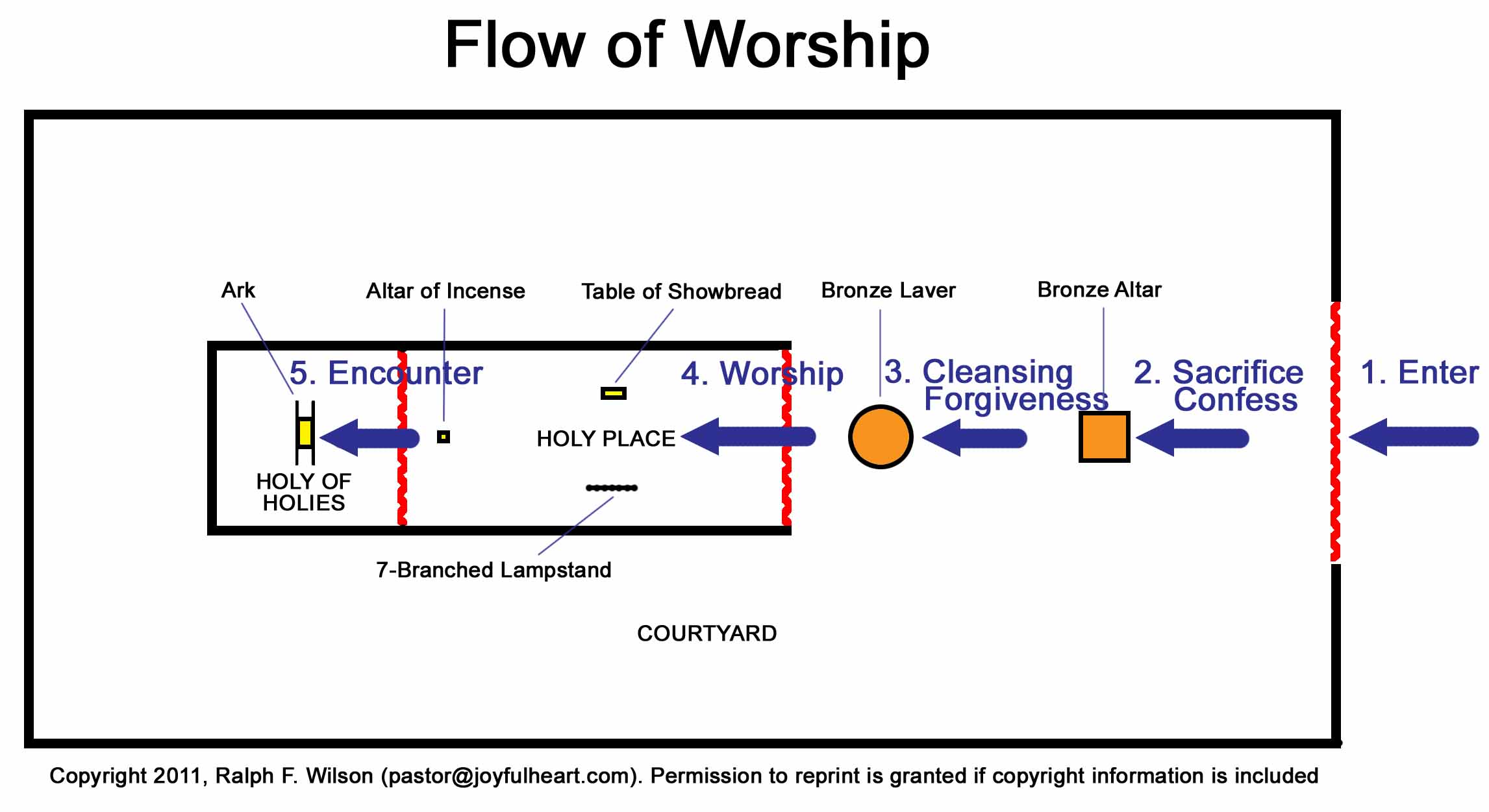
Today, we are going to examine the bronze laver.  See link below to the diagram we've been using:
http://www.jesuswalk.com/moses/images/tabernacle-flow-of-worship-2293x1251x300.jpg

We see God commanding Moses to make this (bronze laver) a feature of the Tabernacle in Exodus 30:18-21 (NET) - - -

17The LORD spoke to Moses, saying, 18“You shall also make a laver of bronze, with its base of bronze, for washing; and you shall put it between the tent of meeting and the altar, and you shall put water in it. 19“Aaron and his sons shall wash their hands and their feet from it; 20when they enter the tent of meeting, they shall wash with water, so that they will not die; or when they approach the altar to minister, by offering up in smoke a fire sacrifice to the LORD21“So they shall wash their hands and their feet, so that they will not die; and it shall be a perpetual statute for them, for Aaron and his descendants throughout their generations.”

A second interesting point:
This bronze laver, the original one, was made of solid bronze, the bronze having been procured from the hand mirrors of women who served outside the outer door of the Tent of Meeting (the Tabernacle).

He made the large basin of bronze and its pedestal of bronze from the mirrors of the women who served at the entrance of the tent of meeting. 
Exodus 38:8 (NET)

BUT, when Solomon built the first Temple, the bronze laver (because its dimensions/design were not specified by God, which I find strange since He was so specific about other things) took on much more grandiose proportions!  We read about this in 1 Kings 7:23-26.  (I don't like the HCSB translation, but I am using it here to prevent you from looking up measure conversions like cubits and baths....)


So, to reiterate, this big (YUGE, in the case of the Temple) wash basin stood behind the bronze altar we studied in the last post and in front of the entrance to the "holy place" of the Tabernacle/Temple. Not only were its presence and purpose specified, the rituals associated with it were laid down by God as well.  Only the Levitical priests could wash there and only before entering or leaving the Holy Place. When a priest entered the Court of Israel, he first made a sacrifice (blood, for the covering of sins) and then he washed at the laver to be cleansed for service.  In a similar way, salvation through Jesus Christ must come before we are prepared for His service.

A priest, after washing, could perform other Temple services.  If he were going into the Holy Place, he would first wash.  If he were coming out of the Holy Place, he would again wash at the bronze laver.  In the court of Israel the altar and laver were made of bronze.  The artifacts inside the Holy Place were made of gold.  These items represented the holiness of God.

You may be wondering what parts of their bodies the Levitical priests would wash.  In Exodus 40:11-16, we learn that upon being consecrated as a priest, a man was washed thoroughly, all over, from the bronze laver, after which he was clothed in priestly garments.  This "all over" washing was done only once.  (We Protestants might think of it as an "ordination".)  But, additionally, we are told in Exodus 30:19-20 (NET) - - look back up in this post, at that those verses again - - that the ritual, every-day washing involved their hands and feet only, right?  One commentator has speculated that the hands were washed because they signify their service to God, whereas the feet represented where they went, their lives and ways.2 

Now, like many other items/places in the Old Testament, the bronze laver and bronze altar are types of Jesus Christ.  I borrow shamelessly from source 2 (see Sources), which expresses this beautifully!

As the altar points to the death of Jesus, so the laver points to the life of Jesus. Blood speaks of a life taken and water speaks of life given. The water in the laver speaks of Jesus, the living Word of God that enters us and gives us eternal life. Jesus said that we are clean because of His Word and that the knowledge of God that comes through His Word is eternal life and is described with the exact same terminolgy in the Hebrew as the sexual union of a man with his wife. As the priest would wash his hands and his feet while coming into the Presence of God (gold) and back out into the world (bronze) so we are continually being cleansed from the corruption of this world by the Word of God. When the Jewish leader named Nicodemus came to Jesus to inquire from Him about the kingdom of God Jesus replied, "unless one is born of the water and the Spirit (Hebrew idiom - "born from above") he cannot enter the kingdom of God." Water brings life to the physical world and so spiritual water (the Word of God) brings Gods spiritual life to us.

As a matter of fact, the entire Tabernacle/Temple is a type of Jesus Christ.  I am enjoying this study and pray you are blessed by it as well. We'll continue it, in the next post.

Sources:

1    https://en.wikipedia.org/wiki/Second_Temple

2    http://www.bible-history.com/tabernacle/TAB4The_Bronze_Laver.htm

Wednesday, March 15, 2017

Stop Right There!


Once a Jewish man going to Temple stepped through the Beautiful Gate to enter the Court of Israel, sometimes called "the first apartment" or "The Holy Place", the first object to arrest his attention would have been The Brazen (or Bronze) Altar.  It was "front and center" from the entrance - - could not miss it.  A priest would have been waiting beside it to receive animal sacrifices.

The altar itself was "foursquare" in shape and burned all day, every day (Leviticus 6:12-13).  Each side was 7.5 feet long.  The altar's height was 4.5 feet.  (You'll thank me in a moment for saving you from Googling the cubit to foot calculation!)
In Exodus 27:1-8 we can read the specific instructions God gave to Moses about the construction of the altar (all the Temple, actually) when Moses was on Mt. Sinai getting the 10 Commandments and other instructions for the people of Israel.

1“Build an altar of acacia wood, three cubitsa high; it is to be square, five cubits long and five cubits wide.b 2Make a horn at each of the four corners, so that the horns and the altar are of one piece, and overlay the altar with bronze. 3Make all its utensils of bronze—its pots to remove the ashes, and its shovels, sprinkling bowls, meat forks and firepans. 4Make a grating for it, a bronze network, and make a bronze ring at each of the four corners of the network. 5Put it under the ledge of the altar so that it is halfway up the altar. 6Make poles of acacia wood for the altar and overlay them with bronze. 7The poles are to be inserted into the rings so they will be on two sides of the altar when it is carried. 8Make the altar hollow, out of boards. It is to be made just as you were shown on the mountain.  (NIV)

It is important to note that no matter who entered this area of the Temple, they could pass no further until confession of sin was made and the sin was pardoned.  No one was "good enough" to skip this step.  Furthermore, no sacrifice (of time, of money, of anything) accomplished this pardon from the Lord other than the shedding of an animal's blood.  This truth is stated in Leviticus 17:11 below (again, God speaking to Moses):

For the life of the flesh is in the blood: and I have given it to you on the altar to make an atonement for your souls: for it is the blood that makes an atonement for the soul. (American KJV)

and by the writer of Hebrews (referring to Jesus Christ's sacrificial death):


Indeed, under the law almost everything is purified with blood, and without the shedding of blood there is no forgiveness of sins.
Hebrews 9:22 (ESV)

When the animal sacrifice was presented, it represented the sinner.  The innocent sacrifice by laying on of hands took on the sins of the sinner.  Then, the priest slit its throat in a violent manner, demonstrating that the consequences of sin are death.  The animal's blood covered the sinner's sin, until the time for the next sacrifice for the sinner's sin.  The animal's blood foreshadowed the "once for all" sacrifice of Messiah Jesus, the Sinless dying for the sinful...  His cleansing blood is forever efficacious.  It forgives all a believer's sins, forever, something the blood of the animal could never do.  The fact that the Bronze Altar burned 24/7, however, did foreshadow the eternality of the Son's ultimate sacrifice.

The horns on the four corners of the altar were not merely decorative.  They represented a place of safe haven for those seeking safety from pursuers.  In the Old Testament the horns of an animal always signified strength and power.  (See Psalm 89:17 and Lamentation 2:3.) The priests were instructed to wipe some of the animal's blood on the horns of the altar.  In this, not only was God's power represented but also His mercy seen.  A man falsely accused of murder could run to the altar and grab its horns.  If he were innocent, his life would be spared.  (See Exodus 21:12-14.) . This happened with King David's son, Adonijah, and also of King David's general, Joab.

All the utensils used in conjunction with the Altar of Bronze were .... wait for it .... made of bronze!  I won't go into each of them here.  Check out the link under Sources if you want more information about each.  I do, however, want to mention the ashes from the sacrifices.  There was a strict protocol for the disposal of them.  Why?  They were considered precious because they signified not only complete destruction but also God's acceptance of the sacrifice.  They also symbolized purification and cleansing.  You may remember that, when Jewish people were in deep mourning, they would rub ashes on their bodies.  Ashes from the altar were also applied to make the unclean clean again.

For the unclean person, put some ashes from the burned purification offering into a jar and pour fresh water over them.
Numbers 19:17 (NIV)

The Bronze Altar was closely linked to another piece of Temple "furnishings" or "appointments", the Altar of Incense.  Because of this, we'll examine it next in our "Temple Tour".

Source:

http://www.bible-history.com/tabernacle/TAB4The_Bronze_Altar.htm